The official history of BMW M is a list of championships and horsepower figures. Its real history is a list of things nobody asked for and everybody is glad exist — the moments when a division founded to go racing looked at a perfectly sensible idea, set it aside, and did something gloriously unreasonable instead. Those experiments are the most fun part of the M story, and, if we are being honest, the part we relate to most. Here are the best of them.
The 3.0 CSL "Batmobile" — too much aero for the road
M's very first car was also its first act of excess. The 3.0 CSL was a homologation special built to win touring car races, and to make its aerodynamics legal for competition, BMW bolted on a front splitter, fins, and an enormous rear wing that earned it the "Batmobile" nickname. There was one problem: that aero was not street-legal in Germany. So BMW's solution was to sell the car with the wings in the trunk, leaving the owner to fit them — a wink-and-a-nod that let the road car homologate the race car's bodywork. The division's whole personality was visible on day one: build what the racing needs, and let the paperwork catch up.
The M1 and Procar — a supercar, then a series to race it in
In 1978 M built the M1, a mid-engine, Giugiaro-bodied supercar — its first car sold to the public, and very nearly a racecar with license plates. The plan was to homologate it for Group 5 racing, which meant building a quantity of them, so BMW sub-contracted the assembly to Lamborghini. Then Lamborghini's finances came apart, the program stalled, and BMW dragged the whole thing back in-house to finish it.
What they did next is the wild part. To go racing while the rules sorted themselves out, M simply invented its own one-make series — the Procar Championship — in which the fastest Formula 1 drivers of the weekend raced identical 470-horsepower M1s as the support event before European Grands Prix. Reigning world champion Niki Lauda won the first season; Nelson Piquet won the second. BMW built a supercar, could not race it the way it intended, and so created a championship where F1 legends would race it for them. The series only ended because M got pulled away to build BMW's first Formula 1 engines.
The M3 GTR — ten road cars to beat a rulebook
By 2001, M wanted to win the American Le Mans Series GT class, and the rules offered an opening: you could run a purpose-built race engine, as long as you also produced ten road-going versions within twelve months. So M built an E46 M3 with a 4.0-liter V8 — the P60, a engine that shared nothing with the regular straight-six M3 — went racing, and won first and third in seven of ten races in a single season.
The competition was furious, arguing the GTR was an in-house prototype wearing a thin disguise, not a car anyone could actually buy. They were not entirely wrong: BMW built the bare minimum of road cars, a literal handful, most of which now live in BMW's own collection. The reaction was to rewrite the rule — raising the production requirement from ten cars to a hundred — which made the GTR ineligible and ended its career after one dominant season. M had built a road-going V8 M3 years before the "real" one, purely to exploit a sentence in a rulebook, won everything, and got the rulebook changed against it. That is about as M as it gets.
The X5 Le Mans — the unreasonable masterpiece
And then there is the one that still does not feel real. In 2000, BMW took an X5 — a family SUV — and installed the 6.0-liter V12 from the V12 LMR, the car that had just won BMW its only overall victory at the 24 Hours of Le Mans in 1999. In the race car the engine made around 580 horsepower with its mandatory air restrictors. In the X5, BMW took the restrictors off, and it made more than 700.
They handed the result to Hans-Joachim Stuck, who drove this 700-horsepower SUV around the Nürburgring in 7 minutes and 49 seconds — a lap so quick that no SUV on earth would beat it for the next nineteen years. It hit 62 mph in 4.7 seconds. BMW built exactly one, never intended to sell it, and seemingly did the whole thing because someone asked "what if?" and nobody in the room could think of a good reason not to. It remains, for our money, the single most gloriously unnecessary thing BMW M has ever done — and we mean that as the highest compliment.
Honorable mention: the clownshoe
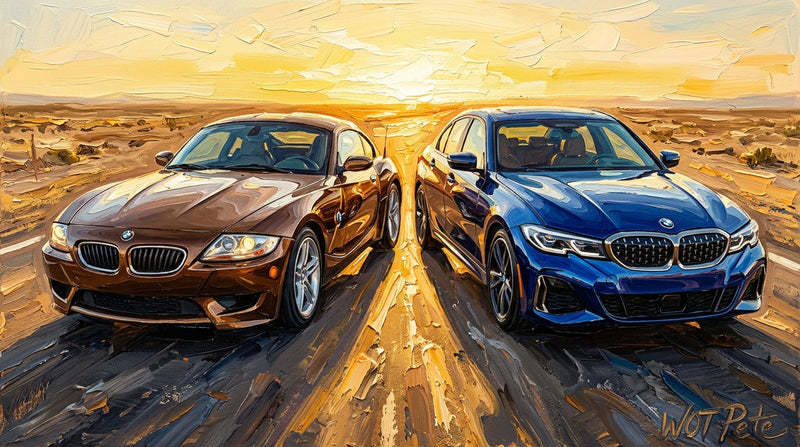
We cannot leave out the Z3 M Coupe — the shooting-brake hardtop M grafted onto the Z3 roadster, with looks so divisive it has been called the "clownshoe" for twenty-five years. Nobody asked BMW to build a tiny, hatchbacked, M-powered hot shoe. M built it anyway. It is now one of the most quietly coveted M cars there is, which is the way these stories tend to end.
Why we love this — and why it sounds familiar
Here is the part where we admit something. We did not write all this just because the X5 Le Mans is wonderful (though it is). We wrote it because we recognize the impulse, because it is the same one running through our own shop. We are not going to pretend our corner of this is a Le Mans program — but the disease is identical.
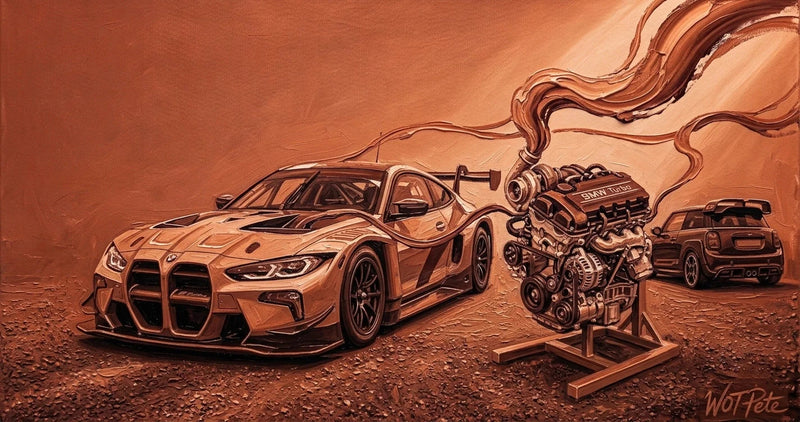
Our MINI is exactly the kind of thing this article is about: a car most people underestimate, built well past the point of sensible, because the platform deserves it and because it is fun. (We made the full case for that in MINI Cooper: the best-kept secret in tuning.) Our Race Support X5 is, no apologies, our own answer to the question BMW asked in 2000 — what happens when you stop treating an SUV like an SUV. And there is an E85 about to join the stable, which, given our track record, is not going to remain a tidy little roadster for very long.
The point of all of it — BMW's and ours — is that the best cars do not come from a spreadsheet. They come from the people who keep asking "what if," and who happen to have the tools to find out. That is what M was founded on, it is the whole story of the division, and it is the kind of shop we are. If you have a "what if" of your own, you know where to find us.
Frequently asked questions
What is the BMW X5 Le Mans? A one-off concept BMW built in 2000: an X5 fitted with the 6.0-liter V12 from the Le Mans-winning V12 LMR race car, making more than 700 horsepower. Hans-Joachim Stuck lapped the Nürburgring in 7:49 in it — a time no production SUV beat for nineteen years. BMW built one and never sold it.
What was the BMW M1 Procar Championship? A one-make racing series in 1979–1980, created by BMW M, in which top Formula 1 drivers raced identical 470-horsepower BMW M1s as the support event to European Grands Prix. Niki Lauda won the first season and Nelson Piquet the second. The M1 itself was partly assembled by Lamborghini before BMW brought the program in-house.
Why was the BMW M3 GTR "banned"? It was not banned so much as ruled out. The E46 M3 GTR used a purpose-built V8 and won the 2001 ALMS GT season under a rule requiring just ten road-going versions. After BMW dominated, the rule was rewritten to require a hundred homologation cars, which made the GTR ineligible, and BMW withdrew. Only a handful of road-legal GTRs were ever built.
What is the "clownshoe" BMW? It is the nickname for the Z3 M Coupe — the shooting-brake, hardtop version of the Z3 M Roadster. Its unusual proportions earned it the name, and it has since become a cult classic.