The BMW B48 is the 2.0-liter turbo four in your 330i, X3, or MINI Cooper S. The high-output version of it makes 302 horsepower in the MINI JCW GP and the X2 M35i. And the full-race version of the same 2.0-liter — the P48 — made around 610 horsepower in DTM. It is the same fundamental engine, taken from a daily-driver four to one of the most extreme four-cylinder race engines BMW has ever built. We specialize in the B48, so this is the story we find most worth telling: how far one block family actually travels, and what the racing end of it means for the engine in your car.
The short version is almost hard to believe: the 2.0-liter block under the hood of a 330i is the same family BMW Motorsport built into a 15:1-compression, 51-psi, 9,000-rpm DTM engine. The road and the race four are not cousins — they are the same bloodline at opposite extremes. Here is how the ladder actually goes.
One block, three states
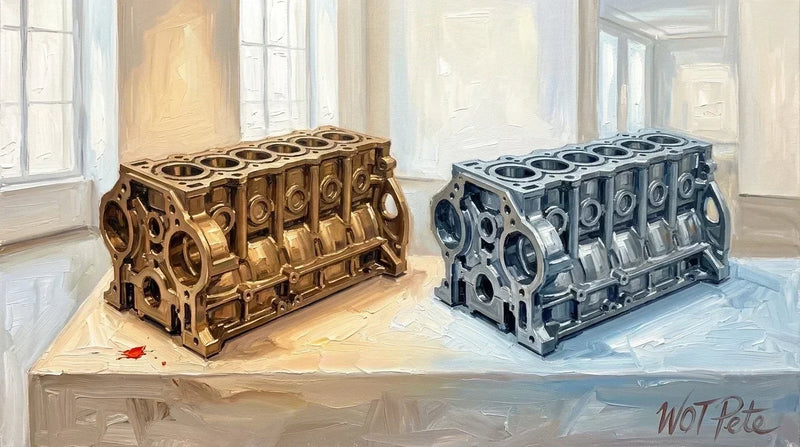
BMW's modern four is a modular design — the four-cylinder member of the B-series family that also gives you the B58 six — built on a closed-deck block with a forged crankshaft and forged, fracture-split connecting rods. That foundation is the reason the same engine can be a frugal commuter motor and a race engine. Three rungs tell the story:
- The B48 — the everyday four, 154 to 255 horsepower depending on the car.
- The high-output B48 — the road peak, 302 to 312 horsepower, with reinforced internals.
- The P48 — BMW Motorsport's purpose-built DTM race four, around 610 horsepower.
And the link between the road and the race engine runs in both directions, which is the part nobody tells. We will get there.
The B48 — the everyday four
The B48 is the volume engine: the 320i and 330i, the X1 through X4, the Z4, the Toyota GR Supra 2.0, and the MINI Cooper S and John Cooper Works. It runs a single twin-scroll turbocharger and direct injection on a closed-deck block with a forged crank and forged cracked rods — the construction that made it the four-cylinder that restored BMW's reputation for four-cylinders after the N20. The full breakdown, including the honest reliability picture and where the tuning ceiling really is, lives in our B48 engine guide.
The high-output B48 — the road peak (JCW GP and M35i)
This is the middle rung, and the most race-adjacent engine you can actually drive on the street. Introduced in 2019, the high-output B48 (the "T-spec," codes B48A20T1 and the later T2) is the same 2.0-liter rebuilt for more boost: a reinforced crankshaft with larger main bearings, new pistons, a lower 9.5:1 compression ratio, and a larger turbocharger feeding a reworked intake. It makes 302 horsepower in the M135i, M235i, and X2 M35i — and 312 in the latest X1 M35i, the most powerful B48 in a BMW.
Its most famous home is a MINI. The MINI John Cooper Works GP uses this 302-horsepower engine, and at its launch it was the most powerful MINI ever built — a stripped, limited-run, track-focused car carrying the hottest road version of the same four that sits in a 330i. If you own a JCW GP, an X2 M35i, or an M135i, you own the road ceiling of this engine family: the version BMW reinforced specifically so it could take real boost. That matters when you tune it, and it matters even more given where this engine came from.
The P48 — the 2.0-liter that raced in DTM
Here is the engine almost no road-car owner knows shares their block. The P48 is a purpose-built 2.0-liter single-turbo inline-four developed by BMW Motorsport for DTM (Deutsche Tourenwagen Masters), raced in 2019 and 2020. It was BMW's first-ever turbocharged DTM engine, replacing an aging V8 — and it is, in the words of its own Wikipedia entry, "full custom-built but partially borrows the cylinder block from the BMW B48 road car engine."
The numbers are from another planet compared to anything on the road:
- Around 610 horsepower in 2019 trim, with another ~30 on push-to-pass — from 2.0 liters.
- 15:1 compression and roughly 51 psi (3.5 bar) of boost from a single Garrett turbo.
- A redline near 9,000 rpm, where it makes its peak torque.
- Dry-sump lubrication, race-grade Aral 102-RON fuel, and a dry weight of just 85 kg (187 lb) including the turbo.
That is what BMW Motorsport extracted from the same 2.0-liter block family that powers a Cooper S. It is one of the most extreme four-cylinder engines BMW has built, and it sits at the top of the exact ladder your B48 is on. We cover it on its own in our closer look at the BMW P48.
The lineage runs both ways
This is the detail that makes the whole story more than trivia. The connection between the road B48 and the race P48 is not one-directional:
- The P48 borrows the B48's block. BMW Motorsport started from the road-car cylinder block — same displacement, same family — and built the race engine from there.
- The road B48 borrows the P48's fuel system. When BMW updated the B48 in 2018 (the "B48TU"), it fitted a 350-bar high-pressure fuel system with Bosch HDP6 pump and HDEV6 injectors — the same injection hardware the P48 race engine runs. The street four and the DTM four share their fuel injection spec.
So the road engine gave the race program its block, and the race program gave the road engine its fuel system. That two-way exchange is exactly the kind of thing that separates an engine family with genuine motorsport DNA from one that just wears the badges.
And it is not history — the B48 is still going racing. For 2026, BMW M Motorsport's new M2 Racing customer car uses a B48-based 2.0-liter four making 313 horsepower with a built-in power-management system for balance-of-performance racing. Notice the number: the accessible 2026 race four (313 hp) and the hottest road four (the 302–312-hp JCW GP and X1 M35i) make nearly identical power, while the all-out P48 DTM engine (610 hp) lives in a different universe entirely. Same block family, three very different missions.
The triad, side by side
| B48 (road) | High-output B48 (JCW GP / M35i) | P48 (DTM race) | |
|---|---|---|---|
| Lives in | 330i, X3, Supra 2.0, MINI Cooper S | MINI JCW GP, X2 M35i, M135i, X1 M35i | BMW M4 Turbo DTM |
| Displacement | 1,998 cc | 1,998 cc | ~2.0 L |
| Compression | 11.0:1 | 9.5:1 | 15:1 |
| Turbo | Single twin-scroll | Single, larger | Single, ~51 psi boost |
| Power | ~154–255 hp | 302–312 hp | ~610 hp (+ push-to-pass) |
| Redline | ~7,000 rpm | ~7,000 rpm | ~9,000 rpm |
| Lubrication | Wet sump | Wet sump | Dry sump |
| Fuel injection | 200→350 bar DI | 350 bar DI | 350 bar DI (Bosch HDEV6) |
| Built for | Daily + a strong tuning base | The road performance peak | DTM Class 1 racing |
The pattern is the same one that runs through BMW's six-cylinder family (B58 to S58 to P58): keep the foundation, add what the mission demands. On the four, the climb is just steeper — from a 154-horsepower commuter to a 610-horsepower thoroughbred on one block design.
What actually carries over to your B48
If you own a B48 — in a BMW or a MINI — the useful question is how much of this lineage is real for you. The honest answer is the encouraging one.
What's shared is the part that counts. The closed-deck block, the forged crank, the forged cracked rods, and — on a B48TU — the 350-bar fuel injection are the same foundation BMW raced. Your engine is not a detuned race motor, but it is built on the same bones, by the same people, with the same hardware in places that matter. That is why the B48 takes a calibration and supporting hardware as well as it does.
What's pure race is most of the P48's numbers — and you can't and shouldn't chase them. 15:1 compression, 51 psi of boost, 9,000 rpm, dry-sump lubrication, and 102-RON race fuel are answers to problems a street car does not have, on an engine rebuilt to a budget and a lifespan a road car would never accept. The high-output JCW GP and M35i version is the realistic ceiling of what BMW built for the road, with the reinforced internals to back it.
What you can do is exploit the same foundation properly — the right calibration built from your own car's data, the supporting hardware matched to your goal, and the discipline to build in the right order. The B48 is the engine we have chosen to go deepest on, and the P48 is the reason we take it as seriously as we do: a block family that BMW trusted to make 610 horsepower in DTM has far more to give a street car than most owners realize.
When you're ready, build your tune for your exact car, and our B48 tuning guide lays out the staged path. If MINI is your world, we make the case for the platform in MINI Cooper: the best-kept secret in tuning.
Bottom line
The B48, the high-output JCW GP and M35i version, and the P48 are one BMW 2.0-liter four across three worlds: the everyday engine in your 330i or Cooper S, the reinforced 300-horsepower road peak, and a 610-horsepower DTM race engine — all on the same block family, with a fuel system that crossed from race to road and a block that crossed from road to race. For an owner, the takeaway is simple and genuine: the four in your car comes from a bloodline BMW trusted at the very top of motorsport, and that foundation is exactly what makes it worth building right.
Frequently asked questions
What engine is the BMW P48? The P48 is a purpose-built 2.0-liter single-turbo inline-four developed by BMW Motorsport for DTM, raced in 2019–2020. It made around 610 horsepower (more on push-to-pass) at nearly 9,000 rpm, with 15:1 compression and roughly 51 psi of boost. It was BMW's first turbocharged DTM engine, and it borrows its cylinder block from the B48 road-car engine.
Is the P48 really based on the B48? Yes — BMW Motorsport built the P48 around the B48 road-car cylinder block of the same displacement. The relationship runs both ways: the updated road B48 (B48TU) uses the same 350-bar Bosch HDEV6 fuel injection as the race engine.
What is the most powerful B48? On the road, the high-output B48 makes 302 horsepower in the MINI JCW GP, X2 M35i, M135i and M235i, and 312 in the latest X1 M35i. In racing, the P48 DTM engine made around 610 horsepower, and the 2026 M2 Racing uses a B48-based four at 313 horsepower.
Is the MINI JCW GP engine the same as the BMW M135i engine? Yes — both use the high-output 302-horsepower version of the B48, with a reinforced crank, larger main bearings, new pistons, a 9.5:1 compression ratio, and a larger turbo. The JCW GP was the most powerful MINI ever built at its launch.
What engine is in the 2026 BMW M2 Racing? A 2.0-liter four based on the B48, producing 313 horsepower with an adjustable power-management system for balance-of-performance racing. It is BMW M Motorsport's grassroots customer race car — proof the B48 family is still racing.
Can I make my B48 like a P48? No, and you shouldn't try. The P48's 15:1 compression, 51 psi of boost, 9,000-rpm redline, dry sump, and race fuel are built for competition, not the street. What you can do is exploit the same shared foundation with a proper calibration and the right supporting hardware on your B48 — which is a lot, because it's the same bloodline.