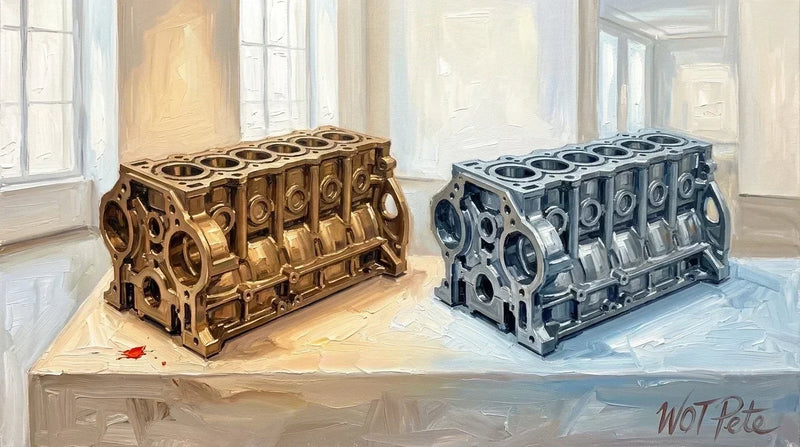
If engine codes name the motor, chassis codes name the car — and they are the single most useful thing to know when you buy parts or a tune, because the chassis code, not the model name, is what actually determines fitment. Two cars can both be "3 Series" and share almost nothing; their chassis codes — say, an E46 and a G20 — tell you instantly that they are two decades and three platforms apart. We use these codes every day to get the right part on the right car, so here is the plain-English story behind them: what the letters mean, how the numbers work, and how to find the one that names your car.
The short version: a BMW chassis code is an internal development designation — a letter for the era, a number for the specific model in that era, and sometimes a suffix for the body style. Read it and you know the generation and platform you are dealing with. Here is the whole system.
What a chassis code actually is
Long before a BMW gets a marketing name like "330i" or "M3," it gets an internal codename for the development project behind it — the platform, the body, the whole car. That codename is the chassis code, and it sticks with enthusiasts and parts catalogs for the life of the car because it is far more precise than the showroom name. BMW has reused "3 Series" across seven generations; each of those generations has its own chassis code, and that is the level of precision parts and tuning require.
The letter — the era
The first letter tells you the generation family:
| Letter | Era |
|---|---|
| E | The classic and modern-classic era, into the early 2010s |
| F | The transition era, roughly 2010 to the early 2020s |
| G | The current generation, from the mid-2010s onward |
| U | Front-drive compact platforms (newer MINIs and UKL-based BMWs) |
| I | Certain electric models |
The "E" is the original and the only one that stands for a word: Entwicklung, German for "development." When BMW ran out of room in the E-series numbering, it simply moved to F, and then to G — those letters don't stand for anything, they are just the next ones in line. So the letter is a rough date stamp: an E-code is older, an F-code is the 2010s transition, a G-code is current. (BMW has since added U for its front-drive compact cars and I for some electric models, though the company now mixes G-codes across combustion and electric cars, so the EV naming is the one place the system gets blurry.)
The number — the specific model
The number after the letter identifies the specific car within that era. It is a sequential development number, grouped loosely by the kind of car, not a tidy "model number" — which is why the 3 Series is an E46 in one generation and a G20 in the next, while the 5 Series of the same eras is an E39 and a G30. You learn them by family rather than by formula, and once you do, they are unmistakable.
Here is the 3 Series, the car most people are decoding, across its generations:
| Chassis | 3 Series generation | Years (approx.) |
|---|---|---|
| E30 | Second-gen (the icon) | 1982–1994 |
| E36 | Third-gen | 1990–2000 |
| E46 | Fourth-gen | 1998–2006 |
| E90/E91/E92/E93 | Fifth-gen (sedan/wagon/coupe/convertible) | 2005–2013 |
| F30/F31/F34 | Sixth-gen (sedan/wagon/GT) | 2012–2019 |
| G20/G21 | Seventh-gen (current) | 2019– |
The suffix numbers (E90 vs E92, F30 vs F31) separate the body styles within one generation — sedan, wagon, coupe, convertible, Gran Turismo.
Why an M3 has its own code
Here is the detail that trips people up: the M version of a car usually gets its own chassis code, separate from the regular model. The M3 is not just a hotter 3 Series in BMW's internal world — it is a distinct enough development project to earn its own code. So:
| M car | Chassis code |
|---|---|
| M3 (F8x era) | F80 |
| M4 (F8x era) | F82 coupe / F83 convertible |
| M3 (current) | G80 |
| M4 (current) | G82 / G83 |
| M2 (first-gen) | F87 |
| M2 (current) | G87 |
So a current 3 Series is a G20, but a current M3 is a G80 — same showroom family, different chassis code, because under the skin they are meaningfully different cars. If you have ever seen "G80" and "G20" used for what sounds like the same car, that is why. (We dig into the engines behind these in our S58 guide and the rest of the engine guides.)
The platform underneath
One more layer, for the curious: several chassis codes can share a single underlying platform. BMW's modern rear-drive cars and larger SUVs sit on the CLAR architecture, while the front-drive compact cars and MINIs use the UKL and FAAR platforms with transverse engines. That is the architecture that explains why a 3 Series and an X5 can share suspension thinking, or why a front-drive 2 Series and a MINI feel related — they are cousins on the same platform, wearing different chassis codes. It is also, incidentally, why the same B48 engine sits longitudinally in one car and transversely in another — the platform decides the orientation.
How a chassis code reads — and why it matters to you
Put it together and any BMW reads cleanly: E46 = development-era, fourth-gen 3 Series. F80 = transition-era M3. G05 = current X5. G87 = current M2.
This is not trivia — it is the most practical number on your car. When you buy a part or a tune, the model name is not enough: a "340i" could be an F30 or a G20, and the two do not share the same parts. The chassis code is what determines fitment. Knowing yours — and being able to read it off a VIN or a forum thread — is what saves you from ordering the wrong part or chasing a tune that was never built for your platform.
That is exactly why we start every build from the specific car. When you build your tune, you tell us your exact chassis and we calibrate for it — because an F30 and a G20 are different cars, and the work has to match.
Bottom line
A BMW chassis code is the car's real name: a letter for the era (E, then F, then G), a number for the model within it, a suffix for the body, and a separate code entirely for the M version. It is more precise than the showroom badge, it is what parts and tuning are organized around, and it is the first thing worth knowing about any BMW you own or are shopping. Pair it with the engine code — which names the motor — and you can read any BMW completely: the car, and what's under the hood.
Frequently asked questions
What does the E, F, or G in a BMW chassis code mean? It marks the era. E stands for Entwicklung, German for "development," and covers the classic-to-early-2010s cars. F is the roughly-2010-to-early-2020s transition generation, and G is the current generation from the mid-2010s on. F and G don't stand for words — they are just the next letters after E.
What is the difference between a chassis code and an engine code? A chassis code names the car (its platform and generation), like F30 or G80. An engine code names the motor, like B58 or S58. You need both to fully identify a BMW — the chassis tells you what fits the car, the engine tells you what's under the hood.
Why does the BMW M3 have a different chassis code than the 3 Series? Because BMW develops the M version as a distinct enough project to earn its own code. The current 3 Series is a G20, but the current M3 is a G80; the previous M3 was an F80 while the 3 Series was an F30. Same family, different chassis code.
What chassis code is my BMW? It depends on the model and year — for example, a 2005–2013 3 Series is an E90-generation car, a 2012–2019 one is an F30, and a 2019-onward one is a G20. You can confirm it from your VIN or by matching your model and year to the generation tables above.
Do BMW chassis codes affect which parts fit? Yes — directly. The chassis code, not the model name, is what determines fitment. Two cars badged "340i" can be different chassis (F30 vs G20) that don't share parts, which is why knowing your chassis code is the first step in ordering parts or a tune correctly.